Schedule C reports
in one click.
Stop manually categorizing expenses into IRS Schedule C lines. Vuuv tracks your income and expenses all year, automatically maps them to the correct Schedule C categories, and generates your tax report in one click.
Free to start. Setup takes 2 minutes.
- 1Gross receipts$86,400
- 28Total expenses$23,180
- 31Net profit$63,220
 Payments
 Bank sync
 E-signatures
Schedule C, already filled in.
Vuuv maps your income and expenses to the actual IRS Schedule C lines.
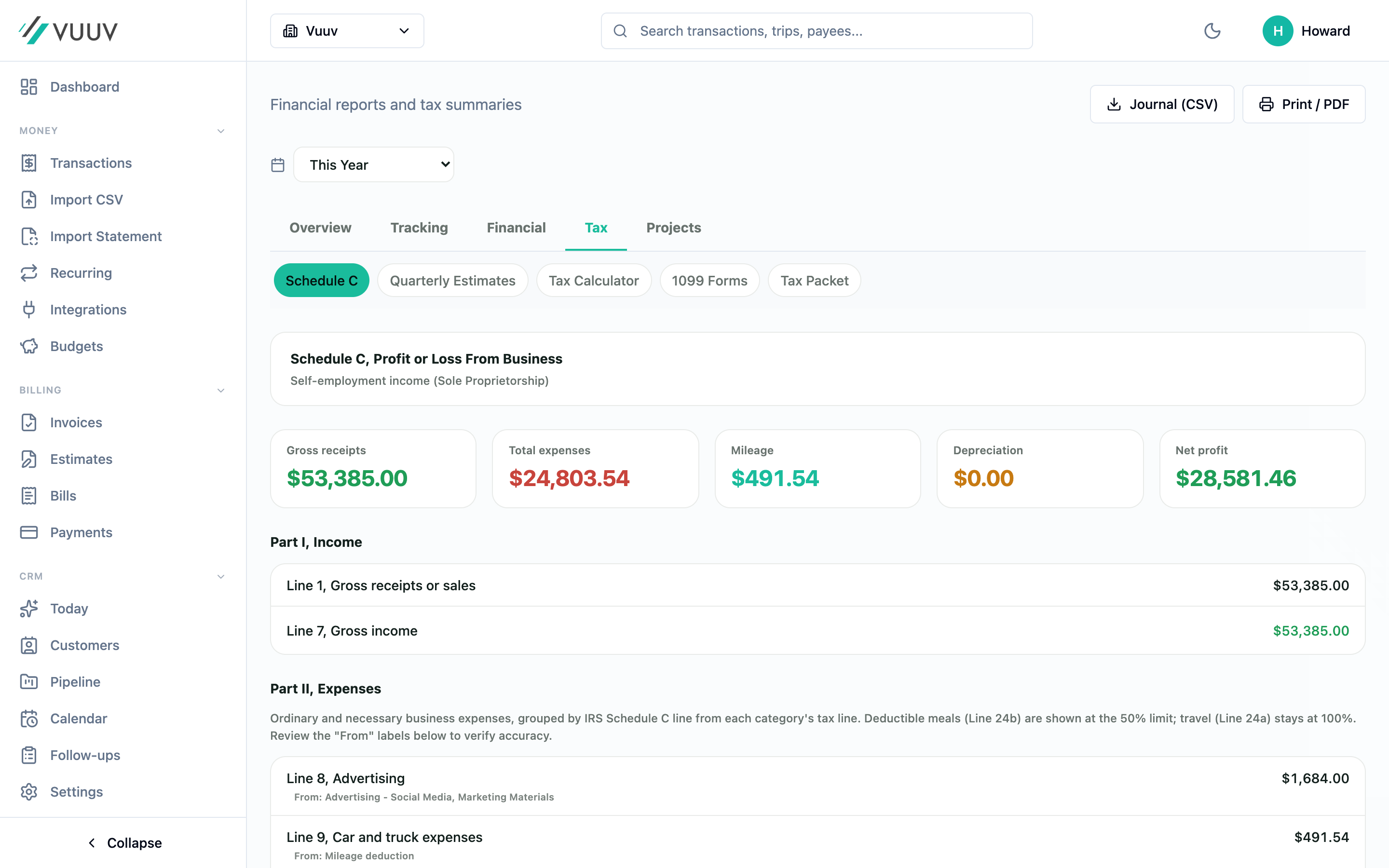
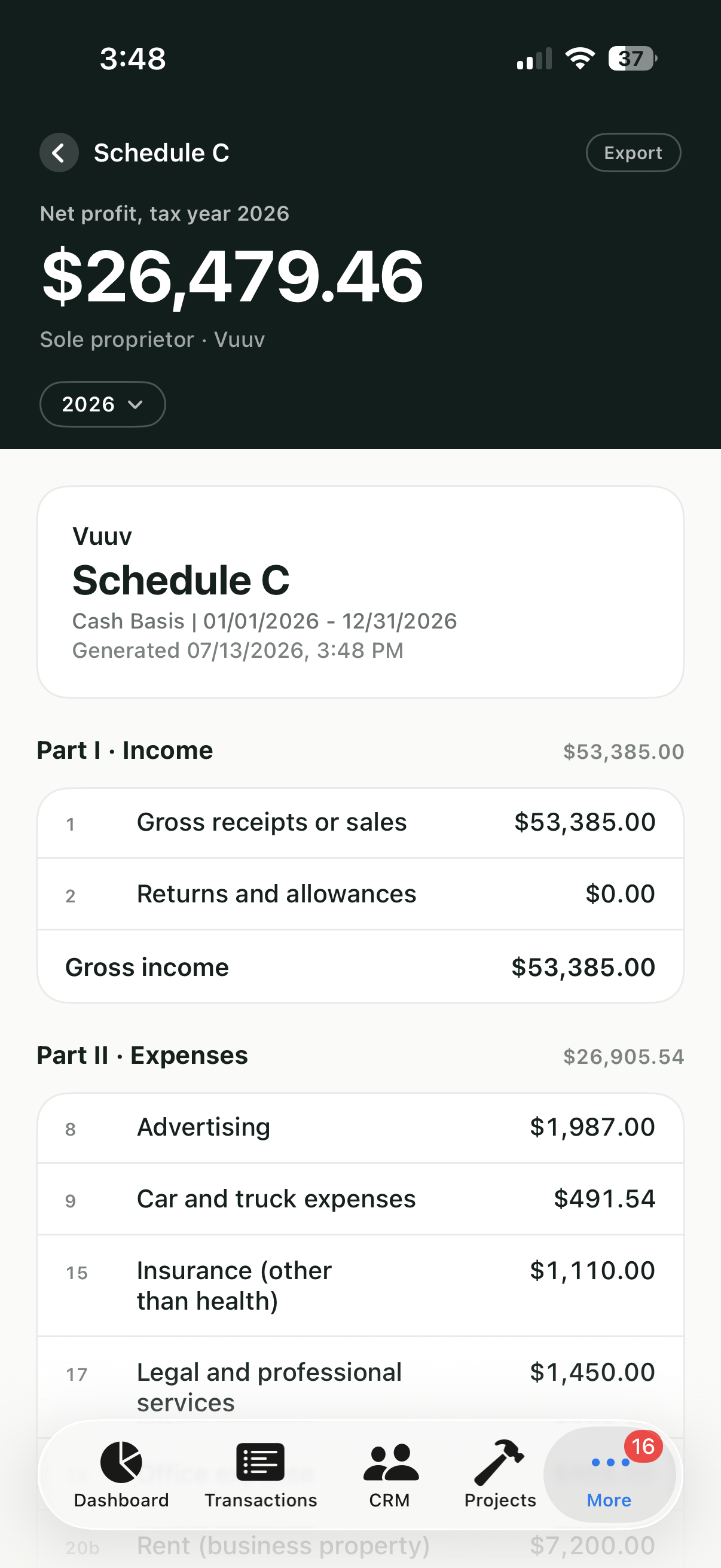
What is Schedule C?
Schedule C (Form 1040: Profit or Loss from Business) is the IRS form that self-employed individuals use to report business income and expenses. It calculates your net profit or loss, which then flows to your personal tax return. If you received any 1099 income or operate a business as a sole proprietor or single-member LLC, you need Schedule C.
Calculate net profit
Schedule C takes your gross income (all the money you earned) and subtracts your business expenses to find your taxable profit.
Report to IRS
The net profit from Schedule C gets added to your personal income on Form 1040. This is how the IRS knows how much you earned from self-employment.
Determine self-employment tax
Your Schedule C profit determines your self-employment tax (Social Security + Medicare), which is calculated on Schedule SE.
Who needs to file Schedule C?
If you're self-employed or run a business, Schedule C is required
Freelancers & contractors
If you work as a consultant, designer, writer, developer, or any type of independent contractor receiving 1099 income, you need Schedule C to report this income and deduct your business expenses.
Examples:
- Consultants
- Graphic designers
- Web developers
- Copywriters
- Photographers
Gig workers
Drivers, delivery workers, and anyone earning through gig platforms must file Schedule C. This includes ride-share drivers, food delivery, task services, and online sellers.
Examples:
- Uber/Lyft drivers
- DoorDash/Instacart
- TaskRabbit workers
- Etsy shop owners
- Amazon sellers
Small business owners
Sole proprietors and single-member LLC owners report their business income on Schedule C. This applies whether your business is full-time or a profitable side hustle.
Examples:
- Sole proprietors
- Single-member LLCs
- Side business owners
- Home-based businesses
- Service providers
Vuuv maps to actual IRS Schedule C lines
Every expense category in Vuuv corresponds directly to Schedule C line items
| IRS Schedule C line | Category | Vuuv tracking |
|---|---|---|
| Part I, Line 1 | Gross Receipts | Income transactions |
| Part II, Line 8 | Advertising | Marketing & ads |
| Part II, Line 9 | Car & Truck Expenses | GPS mileage + vehicle costs |
| Part II, Line 11 | Contract labor | Contractor payments |
| Part II, Line 13 | Depreciation | Asset depreciation schedules |
| Part II, Line 17 | Legal & Professional | Accountant, lawyer, consultant fees |
| Part II, Line 18 | Office Expense | Supplies, equipment, software |
| Part II, Line 20a | Rent (Vehicles, Equipment) | Equipment rental expenses |
| Part II, Line 21 | Repairs & Maintenance | Equipment & property repairs |
| Part II, Line 22 | Supplies | Business supplies & materials |
| Part II, Line 24a | Travel | Airfare, hotels, transportation |
| Part II, Line 24b | Meals (50% deductible) | Business meals |
| Part II, Line 25 | Utilities | Phone, internet, electricity |
| Part II, Line 27a | Other Expenses | Custom categories you create |
Automatic categorization
Vuuv learns from your categorization patterns and automatically assigns Schedule C line items to new expenses. You can always customize categories or create your own.
Everything you need for Schedule C
Vuuv handles the bookkeeping so you can focus on your business
Auto-categorization to Schedule C lines
Every expense is automatically mapped to the correct IRS Schedule C line item. No tax knowledge required. Vuuv knows where everything goes.
Real-time profit & loss
See your net profit at any time. Track income vs expenses throughout the year so you always know your Schedule C bottom line.
Quarterly tax estimates
Vuuv calculates how much you should pay in quarterly estimated taxes based on your Schedule C profit, preventing underpayment penalties.
Receipt attachment
Snap photos of receipts and attach them to expenses. If you're ever audited, you'll have every receipt organized by Schedule C category.
Mileage deduction integration
GPS automatically tracks business miles. At 76¢/mile for 2026, this can be your largest Schedule C deduction. No manual logging needed.
Year-end tax packet
Export your complete Schedule C report, mileage log, receipt images, and all supporting documents in one click. Your accountant will love you.
Stay on top of your Schedule C deductions
It is easy to miss deductions you are entitled to when expenses pile up before tax time. Vuuv helps you capture deductible expenses throughout the year, so more of them are recorded and categorized when you need them, not just the ones you remember in April.
- Vehicle expenses (standard mileage or actual costs)
- Home office deduction (direct + indirect expenses)
- Equipment & software purchases
- Professional development & education
- Advertising & marketing costs
- Business insurance premiums
- Phone & internet (business portion)
- Meals with clients (50% deductible)
- Business travel expenses
- Subscriptions & memberships
- Legal & accounting fees
- Office supplies & postage
Illustrative example: freelance consultant
Sample annual Schedule C deductions
In this example, about $4,600 in reduced tax at a 35% combined rate. Your results depend on your own income and tax situation.
Schedule C questions answered
What is Schedule C?
Schedule C (Form 1040) is the IRS tax form used by sole proprietors and single-member LLCs to report business income and expenses. It calculates your net profit or loss, which gets added to your personal income tax return. If you're self-employed, freelance, or run a small business, you'll need to file Schedule C annually.
Who needs to file Schedule C?
You need Schedule C if you're self-employed as a sole proprietor, work as a freelancer or independent contractor (receiving 1099-NEC or 1099-MISC income), operate a side business, or run a single-member LLC. Even small gig work like Uber, Etsy sales, or consulting requires Schedule C if your net earnings are $400 or more.
What are the most common Schedule C deductions?
Common deductions include: vehicle expenses (either actual costs or the standard mileage rate, 76¢/mile from July 1, 2026 and 72.5¢ for the first half of the year), home office deduction (simplified or actual method), advertising and marketing costs, office supplies and equipment, software and subscriptions, professional services (legal, accounting), business insurance, business meals (50% deductible), travel expenses, continuing education, and phone/internet expenses (business portion only).
When is Schedule C due?
Schedule C is due with your personal tax return on April 15 (or the next business day if it falls on a weekend). If you're self-employed, you also need to make quarterly estimated tax payments: April 15, June 15, September 15, and January 15 of the following year. Vuuv helps you calculate these quarterly payments so you avoid underpayment penalties.
View your Schedule C on screen, even on the free plan
Our free plan lets you see your full Schedule C on screen, all year long, with unlimited transactions. Upgrade to Pro or Elite to export it, plus bank sync, GPS mileage tracking, and full Vuuv AI.
View on screen free. Exportable PDF, CSV, 1099-NEC, and the year-end tax packet are Pro.
We use cookies. Essential cookies keep you signed in. With your permission we also use analytics, plus advertising cookies on our marketing pages. See our Privacy Policy.