Double-entry accounting,
built in.
Vuuv runs a full double-entry ledger under the hood, so your books always balance. You work in plain income and expense categories while Vuuv posts the debits and credits for you.
Free to start. No credit card required.
- Checking · Chase ••4821Debit$2,400.00
- Accounts receivableCredit$2,400.00
 Payments
 Bank sync
 E-signatures
Real books, double-entry.
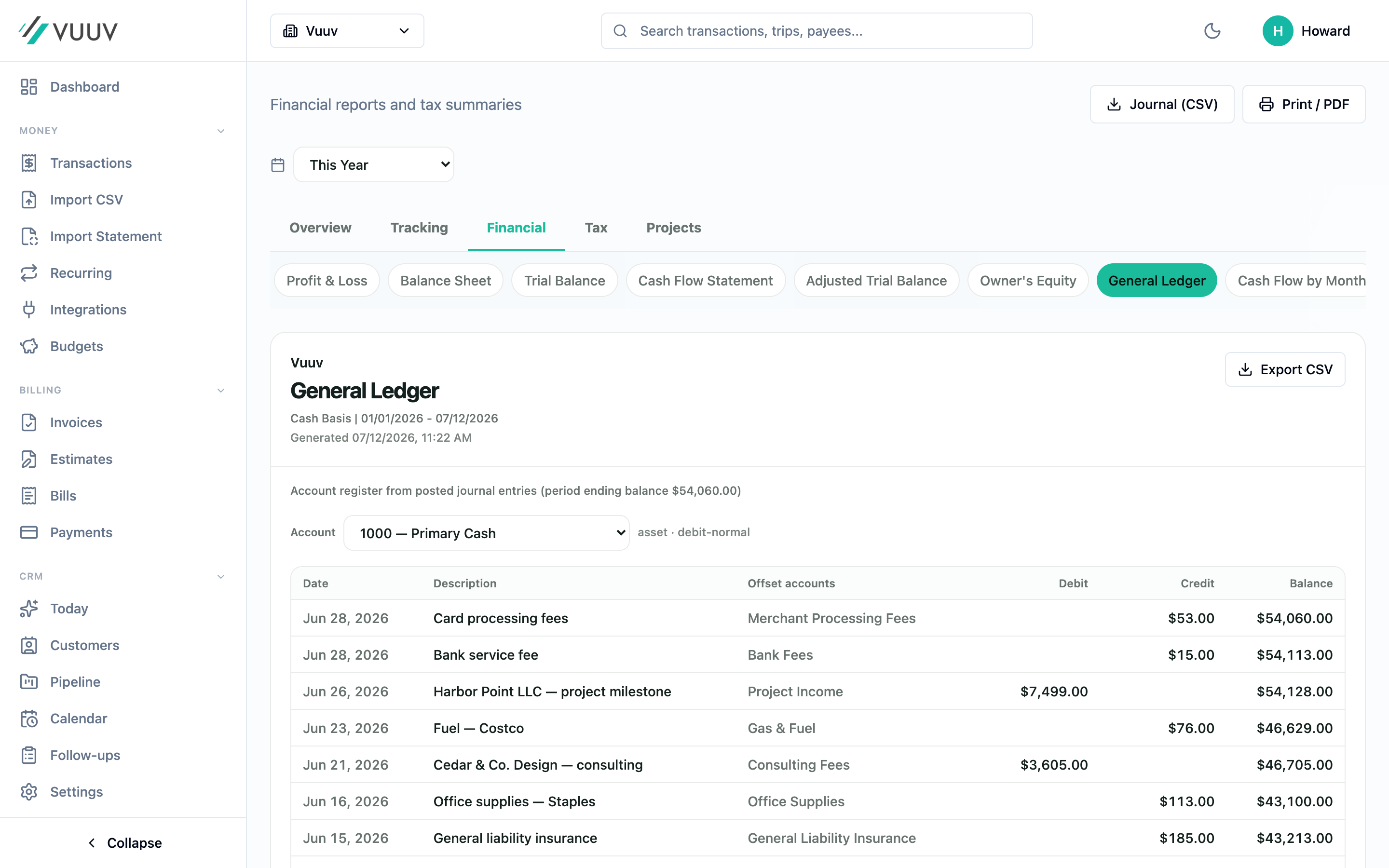
Every transaction posts to a general ledger you can open and drill into.
Why double-entry matters
It is the method accountants, lenders, and the IRS expect, because it is the one that proves your books are right.
Your books always balance
Every transaction posts equal debits and credits, so the accounting equation holds and a one-sided mistake shows up instead of hiding.
A real balance sheet
Only double-entry tracks assets, liabilities, and equity, so you get a true balance sheet that shows what your business actually owns and owes.
Accountant-ready
Auditable, double-entry books are what a CPA, a lender, or the IRS expects, so there is nothing to rebuild at tax time or loan time.
A full ledger, built from your everyday bookkeeping
You categorize income and expenses. Vuuv turns that into a complete set of double-entry books and the statements that come with them.
Automatic chart of accounts
Vuuv builds and maintains your chart of accounts as you work, so every transaction lands in the right account.
General ledger
Every debit and credit posts to a real general ledger you can open, drill into by account, and trust.
Trial balance
A trial balance and adjusted trial balance confirm the books are in balance before you rely on the numbers.
Balance sheet
A balance sheet that ties out to the penny, showing assets, liabilities, and equity at any point in time.
Cash flow statement
Operating, investing, and financing cash flows, built from the ledger alongside your profit and loss.
Bank reconciliation
Match your books to your bank statements so the ledger reflects what actually cleared, not just what you recorded.
How Vuuv keeps it simple
You categorize
Record income and expenses in plain categories, or let bank sync and AI categorization do most of it for you.
Vuuv posts the entries
Behind the scenes, Vuuv posts the matching debits and credits to the ledger, so the books stay in balance automatically.
Your statements build
Your general ledger, trial balance, balance sheet, and cash flow statement come together on their own, ready when you need them.
Clean books your accountant can use
When your accountant or CPA wants the underlying detail, Vuuv exports a clean journal, every debit and credit, as a CSV. The numbers tie out because they come straight from the ledger, so you hand over auditable books instead of a shoebox. Want the concept first? Read double-entry bookkeeping explained or single-entry vs double-entry.
Frequently asked questions
Yes. Every transaction in Vuuv posts balanced debits and credits to a real general ledger, so your books always satisfy the accounting equation: assets equal liabilities plus equity. You get genuine double-entry books, you just do not have to post the entries by hand.
No. You record income and expenses in plain categories, and Vuuv posts the matching debits and credits to the ledger underneath. The double-entry mechanics run automatically, so the accuracy is there without the homework.
An automatically created chart of accounts, a general ledger, a trial balance and adjusted trial balance, a balance sheet, a cash flow statement, and a profit and loss, all built from the same ledger. The full financial statements are available on Vuuv's paid plans.
Yes. Vuuv exports a clean journal, every debit and credit, as a CSV, so your accountant or CPA can work from auditable books instead of a shoebox of receipts. The numbers tie out because they come straight from the ledger.
No, because you never see the complexity. You get the accuracy and the balance sheet of double-entry while working in simple income and expense categories. If you only track income and expenses today, the ledger is still there the day you take on a loan, inventory, or a partner. This is general information, not accounting advice.
We use cookies. Essential cookies keep you signed in. With your permission we also use analytics, plus advertising cookies on our marketing pages. See our Privacy Policy.